Friday, March 22, 2013

What Things?

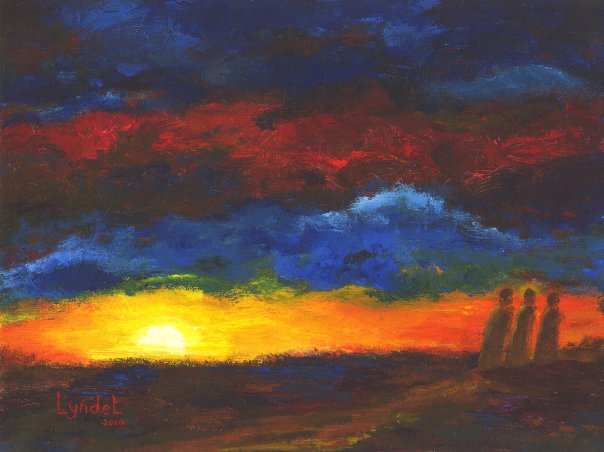
Sometimes we get so wrapped up in our little world that we miss all that is going on around us.  Have you not heard of these things?  What things?  Those on the Emmaus walk were in shock.  They couldn't put things in perspective.  How often do we stumble along living in the past, wondering "what if" instead of being attuned to the reality of now?  How often do we miss the plight of others because we are so caught up in navel gazing?
Just what gives us pause to stop?  Sometimes it seems so hard to be still and know that God is God.  We get lured into thinking we are driving the ship, charting our fate.  It is only when we pause to break bread, nourish our bodies and souls that we catch a glimpse of God's presence with us.  But instead of engaging in that meal, we prefer to just go through the drive through.  Recognizing God in our midst takes time and attention, a willingness to be open to all the things going on around us.
What things have you missed while in the wilderness?  What things prevent you from seeing and hearing the glory of God?  What things are you missing that would help you be the person God wants you to be?  What things are holding you back?  What things are moving you forward?  What things?
May we come to see clearer all things as we near Holy Week.  May we not miss those things which are painful to see, and yet life giving and transforming.   

Thursday, March 21, 2013

What are you discussing with each other?

I wonder how many parking lot conversations would suddenly change if we found ourselves asked this question by Jesus:  what are you discussing with each other?  It is a very humbling question.  I wonder how the chatter of our own mind would change if we stopped and asked ourselves this question.  The road to Emmaus is a familiar one.  I think it is natural for humans to want to move when they have experienced something overwhelming: it is a bodily yearning to be somewhere else, to seek something else, to physically enact movement from grief, depression, sorrow to wholeness and light.
It seems we have a hard time recognizing the divine when we are distraught or walking in perceived darkness.  Somehow our senses are dulled and we are lulled into a shunted existence.  It is literally a journey through darkness to light and sadly can be a long journey.  While we may think ourselves alone, while we may feel alone, we never are.  That is the promise of scripture, the power of the walk to Emmaus.
As Simon and Garfunkel made famous:  hello darkness, my old friend.  I think many people come to know the darkness too well, to wear it as a cloak, a barrier of protection.  How have I made myself blind to those around me?  How have I tuned out those walking with me?  Why is my innermost being turned in on itself?
If we open ourselves, epiphanies are possible, are plentiful.  Growth, transformation, and reaching a destination can be laborious and painful.  Yet, very worthwhile.  God loves us with a tough love that propels us forward toward the light.  As our choir sings so beautifully: I want to walk as a child of the light.  As we move to Easter, it is my prayer that the light will be visible in the distance, that we will find ourselves strangely warmed by the presence of the wholly/holy Other.

Wednesday, March 20, 2013

How will you Believe what I say?

I can imagine Jesus was quite exasperated when he asked this question.  What will it take for us to "just believe?"  We place a good amount of faith in our own intellect, in cause and effect, in action and consequences.  It is often hard to "just believe" when mystery remains elusive, beyond grasp, and does not conform to expectations.
How often do we cling to what we know, cling to Law, when the Gospel awaits us?  Do we prefer Moses with a set of clearly chiseled laws or the lavish grace of a God who meets us on our way?  I have always like the Emmaus story.  Am I so wrapped up in getting to my destination, or wallowing in my disappointment that I fail to see God in my midst?  Can I only see God in the rear view mirror but never in the present?  What veil is this that clouds my eyes?
Where do we recognize or catch glimpses of the divine?  Or, do we prefer to walk around dazed and half asleep?  What will it take to awaken to belief?  Will it be a sudden dawning or a gradual realization that seeps in while walking the walk?
Joy comes in the morning and in the journey.  We cannot remain static.  As a good friend pointed out, transformation happens whether we like it or not.  We do not remain the same.  We have a choice about what kind of transformation takes place and who we journey with.  While our devotion suggests that we have a clear vision and purpose in our life, there is something in me that resists absolute clarity/control.  God surprises us, shapes us, moves us and the vision is not always clear.  Linked to belief is the need for trust.  Do I trust God enough to believe what has been said/promised?
I suppose clarity of vision and purpose comes in action: talking, walking, sharing and knowing.  Hence the need for community; my faith is not a privatized, secret life of devotion and law keeping.  Where two or three are gathered in God's name...we have communion, companionship, tiny shards of clarity.  Will I let go, wipe the pollen from my eyes and see, taste, touch, and hear that God is good?

Tuesday, March 19, 2013

What if you Gain the World, but Lose Your Self?

As we mark Day 30 on our 40 day journey, I think this question creates a fine hinge for our march to Easter morning.  After all, when we began in the desert with Jesus and this was Jesus' temptation: to have the whole world at his fingertips, power, control, and adoration.  Essentially that is our temptation too, every day, every moment. Does my innermost self long for things?  Do I long for adoration?  Do I long for acceptance?  Have I lost my very self, the person God created me to be, in the chase of worldly ambitions?  Does my neediness prevent life and peace?
On the pragmatic side of things, we all have goals.  And, that is a realistic part of being alive.  But Jesus comes to disrupt those goals.  As our devotion suggests, we constantly try to tame Jesus, domesticate Jesus into a mild mannered fellow, a likeable chap that looks like us. Yet, nothing in scripture suggests or supports this perception.  Jesus is the uninvited guest who comes to the banquet in overalls.  He is the person that we love but don't want our friends to know how much.  He is that Holy Spirit who whispers, "what are you really doing here?"  He is that King who disappoints our romantic notions of grandeur and finery.
I do believe that we are here on earth to literally lose our lives.  We first most lose our childish orientation of the world revolving around us.  I try hard to live the motto, "it ain't about me."  Whether I am engaged in liturgy (the work and worship of the people) or engaged in walking with a friend, trying to listen earnestly, or even trying to understand someone else's situation:  it is not about me.  
There is a freedom that comes in finding a deep peace within, a peace that is not conditioned by the presence of any other person or thing in this world.  The more of I lose of my wants, needs, hopes, and expectations the freer I am to be in this moment.  This is the salvation that I glimpse in Jesus:  do you love me enough to let go?  Of everything?  Drop your nets, take up your Cross and follow me.
What am I spending my life doing?  What a piercing question.  So much of life is being caught up in the commerce of this world, the frenetic pace of accomplishment and quantifiable results.  What if I stopped defining myself by what I do?  What if I could answer the question that I am spending my life loving and giving away all that I have?  Instead, have I given up everything for things that do not last?  Am I chasing a love that is not real, not true, not everlasting?
Beyond the commerce of this world, what riches do I treasure in my life?  Where am I poor in spirit?  Where am I grasping on to things that do not last?  What sacrifices in my life have I made that make a true difference?  I suppose I have more questions than answers.  These questions come back to Jesus' command: take up your cross and follow me.
I think good people of faith really struggle with this command.  We think in literal terms of picking up a cross and get lost in the abstraction of what that cross may be.  Certainly we cannot carry Jesus' cross.  Do we each have a cross to bear?  Do I know what my cross is?  Is it of the same essence as what Paul complained about with his thorn in his side?  Can I help another to carry their cross while also carrying mine? How does carrying my cross match up with "my yoke is easy and my burden light?" As we move into Holy Week the Cross will be a primary focus:  were you there when they crucified my Lord?  Beyond singing this heavy hymn once again, how can we answer that question with our life?
The goal of Lent is to find ourselves lost and then found on Easter morning.  What does that journey look like now thirty days in?  Are you seeing buds of new life out of death, seeds of transformation?  What sacrifices have you made and which will you continue to make as a permanent part of your life?  I will continue to hold balance as a primary part of keeping focus on that which truly matters, finding the quiet spaces to lose myself, marvel in grace and mercy, revel in gratitude, and repent of distractions.

Monday, March 18, 2013

Who is Greater? The One at the Table, or the One who Serves?

Nothing makes a group of Lutherans more uncomfortable than talk about evangelizing, serving, or having their feet washed!  We somehow shy away from this notion that we are to be actively engaged with one another: helping, uplifting, sorting through the chaos of life, really serving one another.  As a pastor, I find many who have an active resistance to their leader being engaged in servile activities--no yard work, no dirty/messy jobs, nothing that will break a sweat.  
Yet, Jesus shows us the opposite of the far removed, neatly groomed church person.  He talks with sinners, eats with tax collectors, talks to women, has his feet washed, washes others' feet, touches the sick, gets into the nitty gritty of this life in every way imaginable.  Yes, who among us does not love to go out to eat and to be served?  But, Jesus tells us the truly important people in life are the ones doing the service, not the ones paying for it.  This is wholly contrary to our culture.
I am sure that "serving the Lord" means different things to different people.  For me, being able to give, freely, with the welfare of the other person in mind is key.  For example, my sister and I often joke when we give a gift, especially a spontaneous one that is not tied to a birthday or special occasion: "oh, you shouldn't have done that," she will say.  And I always respond, "I do what I want to do."  Real service flows from love and from being able to give to another without counting the measure.  I am always saddened when folks in church get mad, or family members get angry with one another, and say something like "and after all I have done for you/this church!"  Service is not about keeping score.  You give, let go, and forget.  This is hard to do in a culture that measures everything, even relationships, in terms of power.
There comes a freedom and graceful satisfaction in giving and letting go, in being able to do for another and enjoy the inner fruits of that satisfaction.  I believe the more we do this the more we groom ourselves as followers of Jesus: this is the primary action of those walking the Way.
Yes, people often fail to show gratitude, they disappoint us, or even ignore us.  But, if I am rooted in doing what God commands and not glued to the rear view mirror then I am free from the expectations I might place on others.  Real gift, real service is not tied to that.  Ever.  
How might we better find this inner stewardship as we march to Easter?  How might I better root myself in the freedom of serving?  I pray to forget the cost of discipleship as it is measured by this world and our churches.  I pray to know the cost of discipleship in God's unfolding kingdom, an energy and wisdom which propels us into this sacred moment and the ones to come.

Saturday, March 16, 2013

Which of These is a Neighbor?

It is a parable we've heard many times.  The social outcast, the pariah, is the only one who stops to render aid to an injured man.  Religious authorities pass by without a glance.  This phenomenon has sadly been acted out in many ways time and again; we typically call it the bystander effect.  I recall the famous experiment with seminarians who were released from class late to get to their preaching class (all were supposed to be preaching on the text of the Good Samaritan.)  Every one of them passed a person in need of aid and didn't even stop.  The researchers concluded that our level of "hurriedness" makes us less available to render help to each other.
I've seen this situation acted out many times (the bystander effect and the lack of acting as a Good Samaritan) in my own life.  It makes me wonder to what extend we are paralyzed by our social/cultural norms.  Most recently in the media we were exposed to an "assisted living" employee who refused to render CPR to a dying woman.  Why?  It was against the rules (presumably would invoke some legal jeopardy).
There is a fancy Greek word perichoresis which describes the relationship of God, Christ, Holy Spirit as mutuality and equality, a creative energy that literally dances forth.  A good friend of mine has used this concept to teach how we are to interact with one another:  putting aside our power structures, especially in helping one another, we are called to foster mutuality and relationship over a benefactor/receiver type of relationship which has an inherently unequal cast to it.  Granted, this is a little lofty in thought.  But, what if we thought of each other with this regard?  What if we humbled ourselves enough to realize that whomever we are "helping" may have some way of helping us in return?  What if in reality we are more needy than they are?  What if we allowed a give and take in the relationship beyond just handing off money or provision?
In Jewish circles the word for charity is tzedakah.  It is tied to the Hebrew word for righteous.  It is a sacred duty and obligation to engage in tzedakah (one which I think our Jewish brothers and sisters do better than Christians on the whole).  What would our lives look like if we acted in this sphere of social justice more often?  Beyond just aiding those in need, there is also a responsibility for the well being of the other person: that whatever aid is rendered must help the person become more independent, not more dependent.
I think we would do well to heed the balance inherent in perichoresis and tzedakah.  How often do we rob people of their independence?  How often do we settle for mailing a donation instead of engaging in relationship?  Are we Samaritans?  Enablers?  Benefactors?  Or, faithful people trying to live in a sense of gratitude, righteousness, and hospitable living?
On this balance beam is radical kindness and lavish giving mixed with common sense respect, tough love and the call of each person to live a productive, responsible life.  We do not always strike this balance well, especially in our churches and in our own wounded lives.  If we are not to be defined by our seating capacity in our churches, but by our sending capacity, what difference will that make in our community?  Will I choose to walk by in my hurried state or will I take the time to stop, look, listen, and engage?
Who is my neighbor?  You are.  We are.  Everyone.  Will I open my heart to this reality?  Yes, and I ask God to help me.

Friday, March 15, 2013

Which of You Does not Seek the Lost One?

The way this question is asked, it implies an affirmative sort of answer--why, of course we would seek out the lost sheep.  But, we don't actually do that in reality.  Church families easily become a civic club with rules of inclusion and exclusion.  We don't leave our safe and secure 99 to risk life and limb for that one sheep.  It is counter-intuitive to our way of thinking.
Church as institution has lost its way.  We are not longer engaged in mission but in maintenance.  We have forgotten what it feels like to be lost and to be in desperate need of welcome.  We affirm with our lips that we want new members and yet when those new members come we treat them with suspicion and subject them to our age old power games.
What are we to make of a God who goes after the one sheep?  Will we respond like the bitter older brother of the prodigal son?  Will we fold our arms and become green with envy.  Or, will we let go, join the journey, and truly rejoice when the one who was lost has repented and found wholeness?
Our meditation asks when we ourselves have felt lost.  Sometimes I feel lost sitting right in the middle of church.  I wonder, "what are we doing here?"  Are we gathering as a faith bound community to be energized to go back into the world with love and good news, or are we fulfilling a social obligation, a mental check on our to-do list?  A good friend recently wrote a piece about what it would be like for Jesus to join us in modern times.  Where would he be?  What would he be wearing?  Who would he reach out to?  Would we too, when the time came, scream out "Crucify Him!" because he had disrupted us, turned upside down the way we've always done things?
My faith journey is an ongoing see-saw between being lost and found by God.  When I am lost, it is because I have been chasing a rabbit trail of sorts, enjoying the illusion of being master of my fate.  Then, I trip, fall, find myself bruised and suddenly consoled by the great Holy Spirit who has followed quietly.  I am drawn back into a loving fold and prodded along again with the others on The Way:  prodigals and prodigies alike.  

Thanks be to God for such lavish mercy.